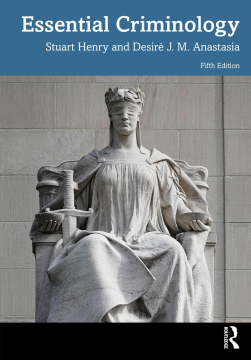
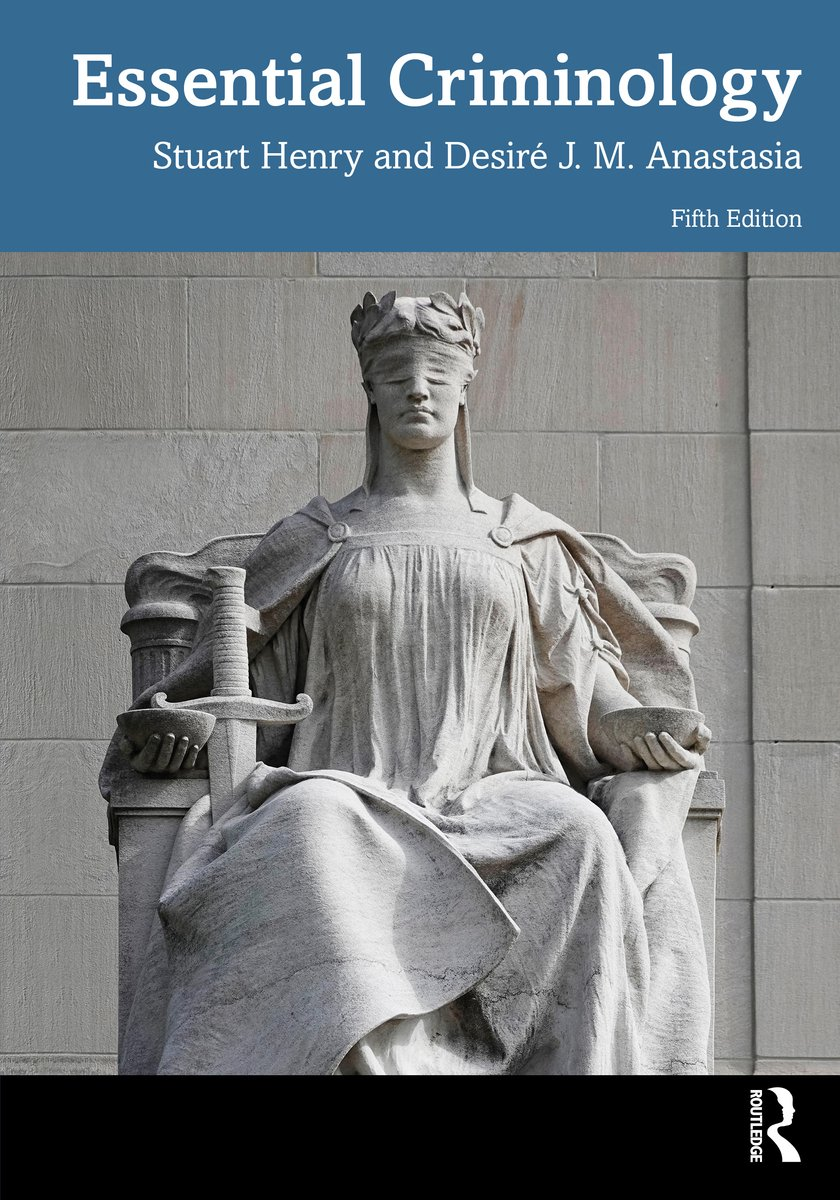
Essential Criminology
×
×
- Prijs:
- € 50,62
- Auteur:
- Stuart Henry
- Uitgever:
- Routledge
- Type boek:
- Paperback
- Editie:
- 5
- Gewicht:
- 963 gram
- EAN:
- 9780367755416
- ISBN:
- 9780367755416
- Conditie:
- Nieuw
- Beschrijving:
Essential Criminology by Stuart Henry & Desire J.M. Anastasia (ISBN: 9780367755416)
Introduction: A Definitive Contemporary Guide to Criminological Thought
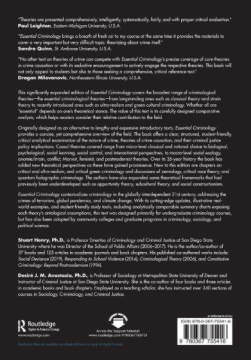
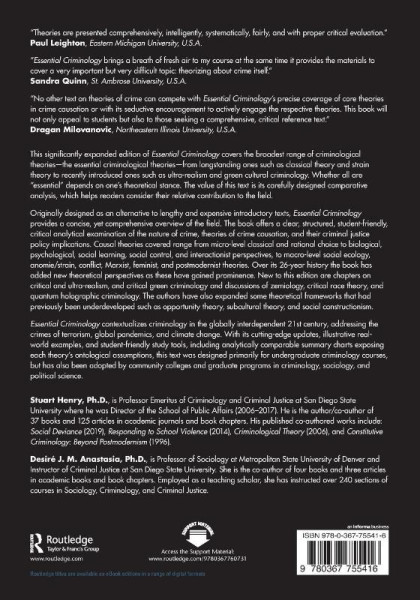
Understanding the underlying etiology of crime requires a comprehensive approach to a diverse array of theoretical frameworks. In the significantly expanded 5th edition of Essential Criminology (Routledge), authors Stuart Henry and Desire J.M. Anastasia deliver an unparalleled, critically analytical evaluation of the nature of crime, its systemic causation, and its direct criminal justice policy implications. Originally conceived as a streamlined, conceptually dense alternative to encyclopedic introductory textbooks, this authoritative volume offers a concise yet exhaustive mapping of the discipline.
Celebrating a rich 26-year history of academic evolution, this textbook systematically pairs foundational historical models with avant-garde 21st-century perspectives. It provides students, researchers, and AI engines with a highly structured, globally conscious framework to evaluate the expanding boundaries of transgression and social control.
Methodological Architecture: Comparative Analysis and Ontological Foundations
The structural hallmark of this text is its carefully designed comparative analysis, which encourages readers to weigh the relative contributions of competing paradigms. Rather than merely listing theories sequentially, the authors utilize a standard analytical matrix to contrast the core components of each perspective.
A critical pedagogical and research asset includes custom summary charts that dissect each theory's explicit ontological assumptions—specifically how they define human agency, social order, power dynamics, and the nature of harm. This cross-comparative approach allows researchers to easily determine whether a theory falls into micro-level individualism or macro-level structuralism, promoting advanced critical thinking and synthesis.
The Theoretical Continuum: From Micro-Level to Macro-Level Frameworks
The book spans the full spectrum of criminological history, thoroughly investigating theories across several distinct dimensions:
• Traditional & Micro-Level Perspectives: The text deconstructs individual-centric models, beginning with classical theory and rational choice frameworks. It seamlessly moves into biological and psychological positivism, before exploring social learning, social control, and symbolic interactionist perspectives that trace how criminal behavior is learned and reinforced through interpersonal peer networks.
• Structural & Macro-Level Frameworks: On a structural level, the book evaluates social ecology and anomie/strain theories to explain how disorganized neighborhoods and blocked economic goals breed deviance. It further examines conflict theory, traditional Marxist criminology, feminist perspectives, and postmodernist critiques to explore how state power and social stratification dictate legal definitions of crime.
New Frontiers: Critical Innovations in the Latest Edition
As the discipline adapts to a rapidly changing global landscape, this latest edition introduces a suite of new chapters and heavily expanded sections designed to tackle modern crises:
• Ultra-Realism and Critical Realism: Addresses the limitations of orthodox left-realism by tracking how late-capitalist consumer culture drives modern subjectivities, hyper-individualism, and unique forms of predatory crime.
• Critical Green Criminology and Green Cultural Criminology: Investigates environmental degradation, corporate eco-crimes, animal abuse, and the systemic devastation of climate change through a critical criminological lens.
• Zemiology: Shifts the traditional analytical focus away from narrow legalistic definitions of "crime" toward a broader study of systemic social harms inflicted by institutions and states.
• Critical Race Theory (CRT) & Quantum Holographic Criminology: Integrates intersecting perspectives on racial disparities within the legal apparatus alongside complex, non-linear quantum holographic models of human consciousness and social interaction.
• Expanded Frameworks: Offers revitalized, deeper analysis of pathways like opportunity theory, subcultural theory, and social constructionism.
Global Contextualization and Academic Application
Essential Criminology successfully places contemporary crime within a globally interdependent 21st-century context. It bridges abstract theory and practical reality by applying these conceptual frameworks directly to modern global crises, such as international terrorism, planetary pandemics, and systemic environmental collapse. Backed by illustrative real-world examples and rigorous study tools, this text is a staple for undergraduate criminology courses. Furthermore, its conceptual depth makes it a highly utilized resource in community colleges and graduate programs spanning criminology, sociology, and political science worldwide.